AI Agents &
Agentic Workflows
AI agents that move work forward
Consult an expert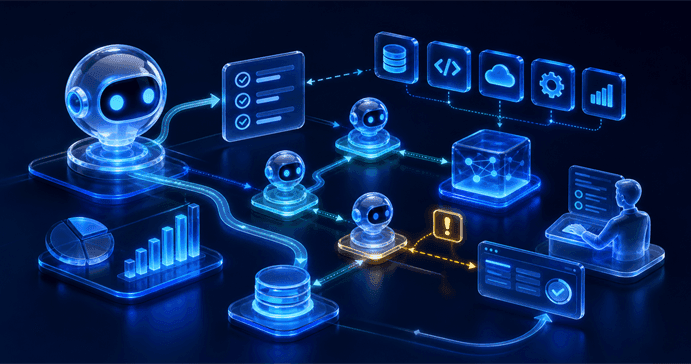
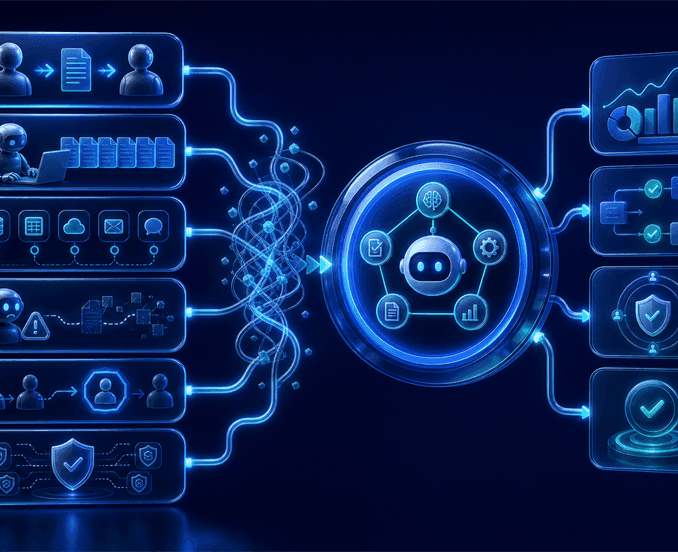
AI agents change what automation can do. Instead of only following fixed rules, agents interpret context, choose from approved actions, coordinate with systems, and help move work through a process.
For enterprises, the value is not an autonomous agent for its own sake. It is agentic workflows that are useful, governed, observable, and connected to the systems where work happens. JBS builds AI agents for real business environments: customer service, insurance operations, finance workflows, sales support, CRM processes, and internal operations.
Identification of agent opportunities, roles, task boundaries, workflows, risks, and outcomes.
Purpose-built agents that work alone or as part of a coordinated workflow across functions.
Task flows where agents retrieve information, reason over context, trigger actions, and hand off to humans.
Review, approval, escalation, override, and monitoring for sensitive or high-risk decisions.
AI-enabled CRM workflows for sales, service, engagement, and operational productivity.
Agents that answer requests, classify issues, retrieve context, and route complex cases.
Agents that prepare proposals, update records, manage follow-ups, and assist operational teams.
Logging, monitoring, permissions, response evaluation, and performance improvement for production agents.
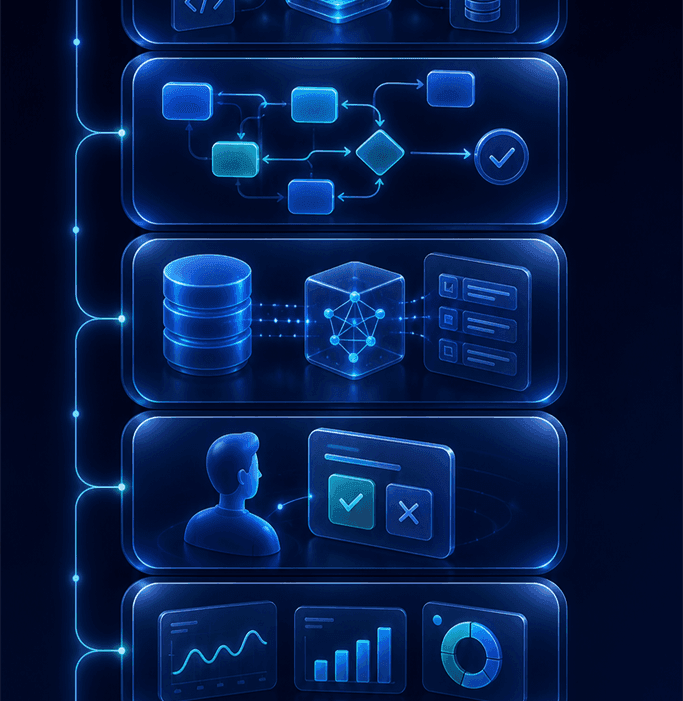
JBS designed a coordinated multi-agent model across claims, underwriting, service, and marketing, reducing manual effort while keeping human review for complex cases.
Learn moreJBS built an agentic commerce assistant that guides customers from discovery to checkout, using intent detection and proactive engagement at high-friction points.
Learn moreJBS built finance AI workflows where agents retrieve records, run approval steps, and surface recommendations, moving from answering questions to completing tasks.
Learn moreJBS developed an AI task prioritization engine that analyzes context, deadlines, and dependencies to recommend the next best action for knowledge workers.
Learn moreJBS deployed AI agents that resolve high-frequency requests across regions and languages, with structured escalation to human agents.
Learn moreWe understand the process, users, data sources, systems, risks, and measurable outcomes.
We evaluate data readiness, integration points, workflow complexity, governance needs, and the technical path.
We create a working prototype or roadmap that validates feasibility before full build.
We design the agents with scalable architecture, integrations, testing, and human-in-the-loop controls.
We launch with security checks, enablement, documentation, monitoring, and adoption support.
We monitor, improve, and extend the agents as the business changes.

We design agents around clear business boundaries: what they can do, cannot do, and when a human must review.

We build governance, logging, and permissions in from the start.

We connect agents to the systems where work actually happens.

We keep humans focused on exceptions, relationships, and judgment.
A software system that interprets context, reasons over information, chooses from approved actions, and helps complete a task. In business settings, agents connect to tools, data, workflows, and human review points.
Traditional automation follows fixed rules. Agents work with variable inputs, unstructured information, and contextual decisions, within clear boundaries and controls.
No. RPA automates repetitive screen or system actions. Agents add reasoning, natural language, retrieval, tool use, and orchestration. The two can work together.
Through approvals, review queues, escalation paths, permissions, audit logs, and clear boundaries on what agents can and cannot do.
Agents can automate large parts of a process, but not every decision should be autonomous. We design workflows where agents handle repeatable work and humans review exceptions and high-risk cases.
JBS helps you design, build, and manage AI agents that support real workflows, connect to your systems, and keep the right level of human control.