Introduction: AI Development Is Entering a Practical Era
AI is no longer just a future idea. It is now part of daily business operations. Companies use it to improve customer service, automate workflows, analyze data, and support faster decisions.
In 2026, businesses are moving beyond basic experiments. They want real results. This is why enterprise AI solutions and AI software development services are becoming important for companies that want to scale with confidence.
Why AI Trends Matter for Businesses in 2026
Technology is changing fast. Customer expectations are also changing. As a result, businesses need smarter systems that can respond quickly, reduce manual work, and improve overall performance.
AI development trends help business leaders understand where the market is going. They also help companies choose the right tools, platforms, and development partners. With the right plan, AI can support growth instead of creating confusion.
Businesses Need More Than Basic AI Tools
Many companies started with simple AI tools. They used chatbots, content generators, or basic automation. These tools helped in small ways. However, they were often not connected to core business systems.
Now, businesses need deeper AI integration. They need AI that works with CRMs, ERPs, websites, mobile apps, support systems, and analytics platforms. This is where AI software development services create stronger value.
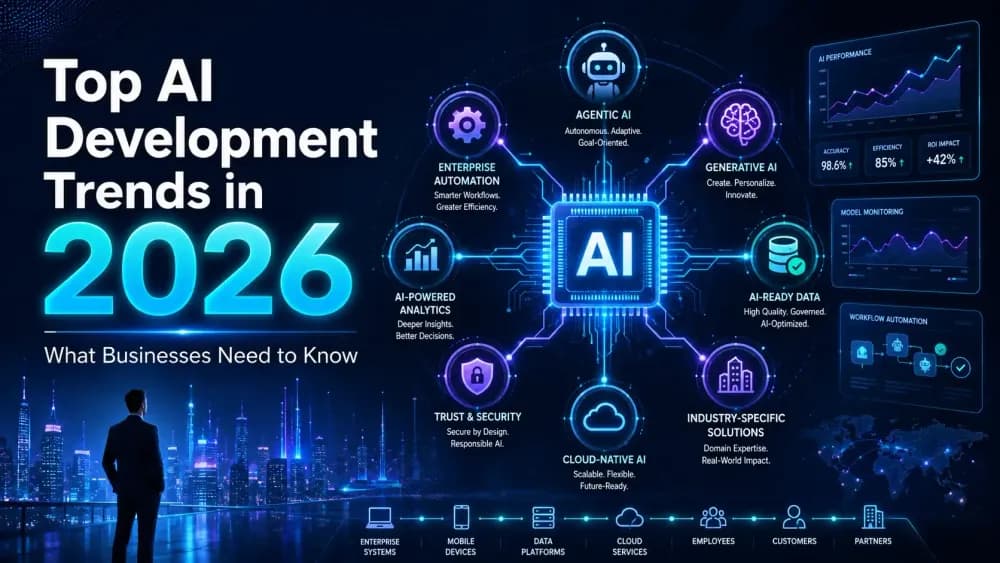
Trend 1: Agentic AI Will Drive Smarter Automation
Agentic AI is one of the biggest AI development trends in 2026. These systems can plan tasks, make decisions, and complete workflows with less human input. They do more than answer questions.
For example, an AI agent can review customer data, prepare a report, send updates, and recommend the next action. This can save time for sales, support, finance, and operations teams.
AI Agents Will Support Business Workflows
AI agents will become more useful when they connect with business tools. They can help teams manage tickets, process documents, qualify leads, and monitor operations.
However, businesses must set clear rules. AI agents should work inside controlled workflows. This helps reduce mistakes and keeps business data safe.
Trend 2: Generative AI Will Become More Business-Focused
Generative AI will continue to grow in 2026. However, the focus will shift. Businesses will not only use it to create text, images, or ideas. They will use it to improve real business processes.
For example, teams can use generative AI to create product descriptions, support replies, proposals, reports, training content, and marketing assets. This helps companies work faster without losing quality.
Custom Generative AI Will Matter More
Generic AI tools are useful. Still, they may not understand a company’s tone, data, products, or internal process. That is why custom generative AI will become more valuable.
With AI software development services, businesses can build solutions that match their own needs. This can improve accuracy, brand consistency, and user experience.
Trend 3: Enterprise AI Solutions Will Move From Pilot to Scale
In the past, many businesses tested AI through small pilots. They wanted to see what worked. In 2026, the focus is changing. Companies now want scalable systems that deliver measurable results.
Enterprise AI solutions help businesses move from experiments to full implementation. They connect AI with existing systems. They also support automation, reporting, security, and governance at a larger scale.
Scaling AI Requires Strong Planning
Scaling AI is not only a technical task. It also needs clear goals, clean data, trained teams, and strong leadership. Without these, AI projects can become expensive and confusing.
Therefore, businesses should start with high-impact use cases. They should define success metrics early. This makes it easier to measure value and improve results over time.
Trend 4: AI-Ready Data Will Become a Core Business Asset
AI depends on data. If the data is poor, the results will also be poor. In 2026, businesses will pay more attention to clean, structured, and trusted data.
AI-ready data helps companies train better models and make better decisions. It also improves automation, personalization, forecasting, and reporting. Without strong data, even advanced AI tools can fail.
Data Governance Will Support Better AI Results
Data governance means setting rules for how data is collected, stored, accessed, and used. It helps businesses protect privacy and reduce risk.
It also improves AI accuracy. When teams know where data comes from and how reliable it is, they can trust AI outputs more. This makes enterprise AI solutions safer and more effective.
Trend 5: AI Software Development Will Become More Secure
Security will become a major part of AI development in 2026. As businesses use more AI tools, they must protect sensitive data, user accounts, models, and workflows.
AI systems can create new risks if they are not built properly. These risks may include data leaks, wrong outputs, prompt attacks, and unauthorized access. Therefore, secure development must start from day one.
Businesses Will Need Built-In AI Security
AI security should not be added at the end. It should be part of planning, design, development, testing, and deployment. This helps reduce risks before the system goes live.
Reliable AI software development services should include secure authentication, role-based access, monitoring, testing, and compliance support. This helps businesses launch AI products with more confidence.
Trend 6: AI Observability Will Become Essential
As AI systems become more complex, businesses need to see how they work. AI observability helps teams monitor performance, errors, costs, model behavior, and user interactions.
This is important because AI systems can change over time. A model may give weak answers. An agent may take the wrong step. A workflow may become slow or costly. Observability helps teams find and fix these issues.
Monitoring Will Improve Trust
Businesses need trust before they can scale AI. Teams must know whether AI outputs are accurate, safe, and useful. Monitoring helps answer these questions.
It also supports better decision-making. When companies track AI performance, they can improve models, control costs, and reduce failure points.
Trend 7: Industry-Specific AI Will Grow Faster
Every industry has different needs. A retail business may need AI for product recommendations. A healthcare company may need support for patient workflows. A finance company may need fraud detection and risk analysis.
In 2026, more businesses will choose industry-specific AI instead of one-size-fits-all tools. This helps them solve real problems faster.
Custom AI Will Create Stronger Business Value
Custom AI works around a company’s process, users, data, and goals. It can support better automation and more accurate insights.
This is where enterprise AI solutions and AI software development services work together. One helps businesses scale AI across departments. The other helps build the right software for specific needs.
Conclusion: 2026 Is the Year of Practical AI Growth
AI development in 2026 is focused on value, scale, security, and trust. Businesses are no longer impressed by simple AI experiments. They want systems that solve real problems and improve daily operations.
From agentic AI to AI-ready data, each trend shows one clear message. AI must become practical. It must connect with business goals. It must also remain secure, measurable, and easy to manage.
Companies that invest early will gain an advantage. With the right enterprise AI solutions and reliable AI software development services, businesses can automate smarter, serve customers better, and build stronger digital products for the future.