Understanding AI in Simple Words
Artificial intelligence, or AI, means using smart technology to perform tasks that usually need human thinking. These tasks may include learning, problem-solving, decision-making, prediction, and communication.
In business, AI helps companies work faster and smarter. It can automate routine tasks, study large amounts of data, support customers, and improve daily operations. Today, enterprise AI solutions and AI software development services make AI more practical for businesses of all sizes.
Why AI Matters for Modern Businesses
Businesses deal with more data, more customers, and more competition than ever before. Because of this, manual work is not always enough. Companies need tools that can process information quickly and support better decisions.
This is where AI becomes useful. It helps teams save time, reduce errors, and focus on important work. With enterprise AI solutions, businesses can connect AI with their systems, workflows, and long-term goals.
AI Is Not Only for Large Companies
Many people think AI is only for big companies. However, that is not true anymore. Small and mid-sized businesses can also use AI to improve customer service, marketing, sales, finance, and operations.
For example, a small business can use AI chatbots to answer common questions. It can also use AI tools to write product descriptions, analyze customer behavior, or manage leads. With the right AI software development services, even a growing business can build custom AI tools that fit its needs.
How Artificial Intelligence Works in Business
AI works by using data. It studies patterns in that data and then uses those patterns to make predictions, suggestions, or decisions. The more useful and clean the data is, the better the AI system can perform.
For example, an AI system can study past sales data and predict which products may sell more next month. It can also study customer support questions and suggest faster answers to support teams.
Data Is the Foundation of AI
AI needs data to learn. This data can come from websites, apps, customer records, sales systems, emails, support chats, and business software. When this information is organized well, AI can turn it into valuable insights.
However, poor data can lead to poor results. That is why businesses must focus on clean, accurate, and secure data before using AI at scale. Good data helps AI become more reliable and useful.
Common Types of AI Used in Business
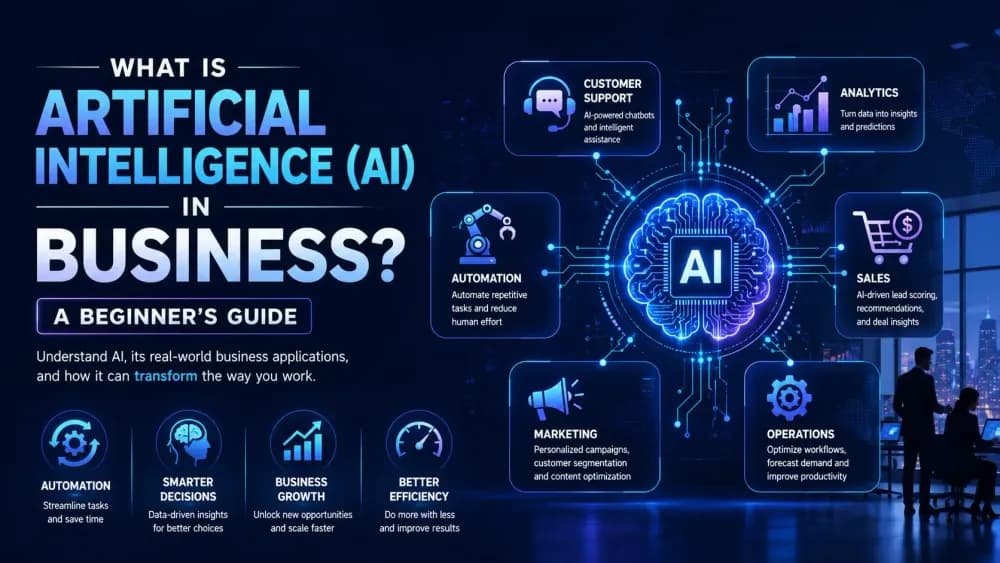
Businesses use different types of AI depending on their goals. Some AI tools help with automation. Others help with analytics, customer support, content creation, or forecasting.
The best type of AI depends on the business problem. A retail brand may need product recommendations. A finance company may need fraud detection. A service business may need automated customer support.
Machine Learning
Machine learning is a common type of AI. It allows systems to learn from data and improve over time. Businesses use it for predictions, customer behavior analysis, risk scoring, and demand forecasting.
For example, machine learning can help a company predict which customers may stop buying. This allows the business to take action early and improve customer retention.
Generative AI
Generative AI creates new content based on instructions. It can write text, create images, summarize documents, generate ideas, and support communication.
Businesses use generative AI for marketing content, email drafts, product descriptions, reports, training material, and customer service replies. It helps teams produce work faster while keeping quality in mind.
How Businesses Use AI in Daily Operations
AI can support many daily business tasks. It can sort emails, process invoices, answer customer questions, create reports, and organize data. This reduces manual work and helps teams stay productive.
It can also help managers understand performance. AI can show what is working, where delays happen, and which areas need improvement. As a result, businesses can make better operational decisions
Customer Support Automation
Customer support is one of the easiest areas to understand AI. AI chatbots can answer common questions, share order updates, and guide users to the right information.
This does not mean humans are not needed. Instead, AI handles simple tasks while human agents manage complex issues. This improves response time and customer experience.
Sales and Marketing Support
AI helps sales teams find better leads. It can study customer behavior and show which prospects are more likely to buy. This helps teams focus their efforts.
Marketing teams also use AI to improve campaigns. AI can suggest content ideas, personalize emails, segment audiences, and analyze ad performance. This helps businesses spend their budget more wisely.
Benefits of Artificial Intelligence in Business
AI offers many benefits for businesses. It saves time, improves accuracy, supports better decisions, and helps companies serve customers faster. It can also reduce costs by automating repetitive tasks.
Another major benefit is scalability. As a business grows, work becomes more complex. AI can help manage larger workloads without slowing down the team.
Better Decision-Making
Good decisions depend on good information. AI can analyze large amounts of data and turn it into clear insights. This helps leaders understand trends, risks, and opportunities.
For example, AI can show which products perform best, which customers need attention, and which processes waste time. This makes planning easier and more accurate.
Improved Efficiency
AI improves efficiency by reducing slow manual work. It can complete repetitive tasks quickly and consistently. This gives employees more time for creative, strategic, and customer-focused work.
With enterprise AI solutions, businesses can apply automation across departments. Sales, finance, HR, operations, and support teams can all benefit from smarter workflows.
The Role of AI Software Development Services
Ready-made AI tools can help with simple tasks. However, many businesses need solutions that match their exact workflows. This is where AI software development services become important.
A development team can build custom AI tools for specific business needs. These tools can connect with existing platforms such as CRM systems, websites, mobile apps, ERPs, and dashboards.
Custom AI Fits Real Business Needs
Every business works differently. A generic tool may not understand your customers, processes, or data. Custom AI can solve this problem.
For example, a company may need a custom chatbot, smart reporting dashboard, recommendation engine, or automated document processing system. AI software development services help turn these ideas into working solutions.
Challenges Businesses Should Know Before Using AI
AI is powerful, but it needs careful planning. Businesses should not use AI just because it is popular. They should first identify the problem they want to solve.
Data quality is another challenge. If the data is old, incomplete, or confusing, AI may give weak results. Companies also need to protect privacy and keep sensitive information secure.
Human Oversight Still Matters
AI should support people, not replace every decision. Humans still bring judgment, creativity, empathy, and business understanding. These qualities are important.
The best results happen when AI and people work together. AI provides speed and insight. People provide direction and context.
How to Start Using AI in Your Business
Businesses should start small. They can begin with one simple use case, such as customer support automation, reporting, lead scoring, or email personalization. This reduces risk and makes adoption easier.
After that, they can review results and expand slowly. Once the first AI project works well, the business can use AI in more departments.
Choose the Right AI Partner
The right partner can make AI easier to understand and implement. A good team will study your goals, review your systems, and suggest the best approach.
With the right enterprise AI solutions and reliable AI software development services, businesses can build AI systems that are useful, secure, and scalable.
Conclusion: AI Is a Practical Tool for Business Growth
Artificial intelligence in business is not as complicated as it may sound. At its core, AI helps companies use data, automate work, improve decisions, and serve customers better.
It can support many areas, including sales, marketing, customer support, finance, operations, and strategy. More importantly, it helps businesses become more efficient and prepared for growth.
With strong enterprise AI solutions, companies can scale AI across their operations. With expert AI software development services, they can build custom tools that match their real needs. In the end, AI is not only for the future. It is already helping businesses work smarter today.