Introduction: AI Is Changing Business Operations
Artificial intelligence is now a practical business tool. Companies use it to improve daily operations, reduce manual work, and make faster decisions. It helps teams work smarter without adding more pressure.
Today, businesses need more than simple automation. They need enterprise AI solutions and AI software development services that connect with real workflows. As a result, AI is becoming a key part of modern business operations.
Why Businesses Are Adopting AI Faster
Businesses face rising costs, growing competition, and higher customer expectations. Therefore, they need smarter ways to manage work. AI helps companies handle more tasks with better speed and accuracy.
In addition, AI gives leaders access to better insights. It can study data, find patterns, and highlight problems early. This helps businesses respond faster and plan with more confidence.
AI Supports Practical Business Growth
AI is not only about advanced technology. It is about solving real problems. It helps companies save time, improve service, and reduce operational waste.
With the right AI software development services, businesses can build tools that fit their exact needs. This makes AI more useful because it works around existing systems and goals.
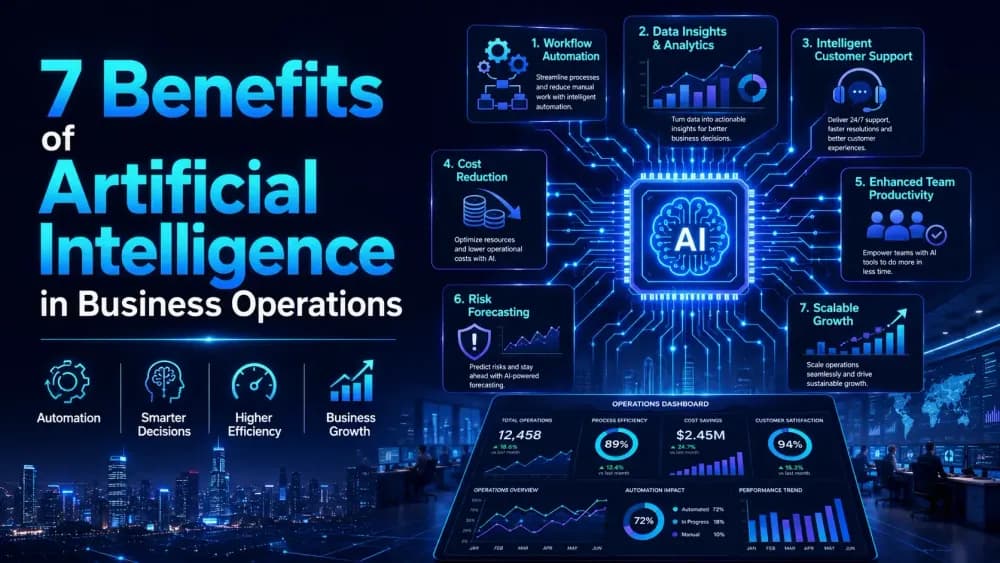
Benefit 1: Better Automation of Repetitive Tasks
One of the biggest benefits of AI is automation. Many teams spend hours on routine tasks such as data entry, email sorting, invoice checks, report creation, and ticket routing. These tasks are important, but they can slow teams down.
AI can complete these tasks faster and with fewer errors. It can read data, update records, send alerts, and move work between systems. This allows employees to focus on more valuable tasks.
Automation Saves Time Across Departments
AI automation can support many departments. Sales teams can use it for lead scoring. Finance teams can use it for invoice processing. Support teams can use it for ticket management.
As a result, the whole business becomes more efficient. Teams spend less time on manual work and more time on strategy, service, and growth.
Benefit 2: Faster and Smarter Decision-Making
Good decisions need good data. However, many businesses have data spread across different systems. This makes it hard to see the full picture.
AI solves this problem by analyzing large amounts of data quickly. It can show trends, risks, and opportunities. Therefore, leaders can make better decisions in less time.
Real-Time Insights Improve Strategy
AI can turn raw data into clear insights. It can track sales performance, customer behavior, market changes, and operational issues. This gives leaders a stronger view of the business.
Enterprise AI solutions make this even more powerful. They connect data from multiple departments and create a more complete view of performance.
Benefit 3: Improved Customer Experience
Customers expect fast and helpful service. They also expect brands to understand their needs. AI helps businesses meet these expectations in a simple and effective way.
For example, AI can power chatbots, product recommendations, personalized emails, and smart support tools. It can also help teams respond faster to customer questions and complaints.
Personalization Builds Stronger Relationships
AI can study customer behavior and suggest relevant products, services, or content. This makes the customer experience more personal and useful.
When customers feel understood, they are more likely to trust the brand. Over time, this can improve loyalty, repeat purchases, and customer satisfaction.
Benefit 4: Lower Operational Costs
Every business wants to reduce unnecessary costs. AI helps by improving efficiency and reducing waste. It can automate slow tasks, reduce errors, and improve resource planning.
For example, AI can help companies avoid overstocking, reduce downtime, and manage staff schedules better. These small improvements can create strong cost savings over time.
AI Helps Reduce Human Error
Manual work can lead to mistakes. A wrong entry, missed email, or delayed response can affect business performance. AI reduces these risks by handling repetitive tasks with consistency.
However, human oversight still matters. The best approach is to let AI handle routine work while people manage important decisions and complex situations.
Benefit 5: Stronger Productivity and Team Performance
AI gives teams more time to focus on meaningful work. Instead of spending hours on admin tasks, employees can focus on customers, planning, creative work, and problem-solving.
This improves productivity. It also reduces stress because employees do not have to manage the same repetitive tasks every day.
Teams Can Work With Better Focus
When AI handles routine work, teams can focus on tasks that need human judgment. This creates better work quality and faster output.
AI software development services can also build custom tools for specific departments. These tools can help teams complete work faster without changing their full process.
Benefit 6: Better Risk Management and Forecasting
AI can help businesses identify risks before they become serious. It can detect unusual patterns, forecast demand, and highlight possible problems in operations.
For example, AI can help predict customer churn, supply chain delays, fraud risks, and equipment failures. This gives businesses more time to respond.
Predictive Insights Help Businesses Prepare
Forecasting is important for smart planning. AI can study past data and current trends to predict future needs. This helps businesses prepare inventory, budgets, staffing, and marketing plans.
Enterprise AI solutions can support this at a larger scale. They help companies connect forecasting with real business systems and make planning more accurate.
Benefit 7: Easier Scaling and Business Growth
As a business grows, operations become more complex. More customers, more orders, more data, and more team members can create pressure. AI helps businesses manage this growth more smoothly.
AI can support larger workloads without slowing down teams. It can automate support, organize data, improve reporting, and help leaders make better growth decisions.
AI Makes Growth More Manageable
Growth can create new challenges. Processes that work for a small team may not work for a larger business. AI helps companies build systems that can scale with demand.
With enterprise AI solutions, businesses can improve operations across departments. With reliable AI software development services, they can build custom tools that support long-term growth.
How to Start Using AI in Business Operations
Businesses should start with clear goals. They should identify where teams lose time, where errors happen, and where better insights are needed. This helps them choose the right AI use cases.
Next, they should review their data and existing systems. Clean data and proper integration are important. Without them, AI may not deliver the best results.
Start Small, Then Scale
A business does not need to automate everything at once. It can start with one high-impact workflow. For example, it can automate customer support, reporting, invoice processing, or lead management.
Once the first project works well, the company can expand AI into more areas. This step-by-step approach reduces risk and improves adoption.
Conclusion: AI Creates Smarter Business Operations
Artificial intelligence offers many benefits for business operations. It improves automation, decision-making, customer experience, productivity, forecasting, and growth. It also helps companies reduce waste and work with more confidence.
However, success depends on the right strategy. Businesses need clear goals, quality data, and systems that match their real needs. That is why enterprise AI solutions and AI software development services are so valuable.
In the end, AI is not only about technology. It is about better work, better service, and better results. Businesses that use AI wisely can build smarter operations and prepare for a stronger future.